
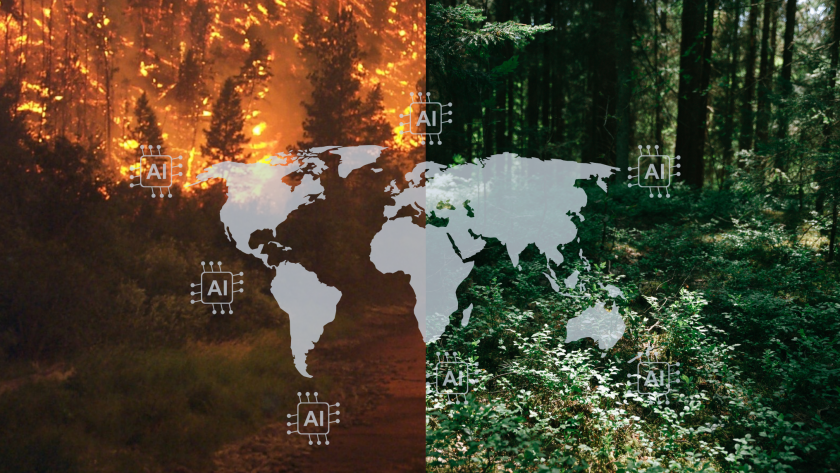
In 2025, Artificial Intelligence (AI) and Machine Learning (ML) continued to accelerate innovation in forestry and environmental science, reshaping how ecosystems are monitored, managed, and protected. These technologies have moved beyond pilot concepts into operational tools used for detecting wildfires earlier, identifying pest outbreaks, mapping forest health, and supporting strategic decision-making. By integrating AI with remote sensing, drones, and big data systems, researchers and practitioners are addressing longstanding challenges and enhancing sustainability outcomes in forest landscapes.
AI and ML solutions have become catalysts for real-time monitoring, predictive analytics, and smarter resource management, making it possible to act proactively rather than reactively in the face of climate change and biodiversity loss.
Key Technological Advances in AI & Forestry
1. Deep Learning for Forest Health and Pest Detection
One major advance in 2025 was the development of deep learning models tailored for detecting pest infestations and disease symptoms in forests. Traditional field surveys are labor-intensive and time-consuming, while AI enables automated, high-resolution analysis of imagery captured by drones or satellites.
Example: FID-Net
A new neural network called FID-Net, built on state-of-the-art object detection frameworks like YOLO, has been designed specifically to identify pest-infested trees from UAV imagery. This model enhances feature extraction, fuses multiple scales of data, and incorporates spatial analysis to determine infection patterns, hotspots, and probable areas of spread. Its performance metrics show significant improvements over conventional detection systems, enabling more accurate and actionable pest surveillance.
Applications
- Early warning for outbreaks of beetles, defoliators, or fungal diseases.
- Prioritizing forest units for treatment or salvage.
- Informing adaptive pest management strategies.
2. Machine Learning for Wildfire Detection and Temperature Reconstruction
Early detection and rapid response remain critical for effective wildfire management. While satellite and ground sensors have long been used, ML now enables earlier and more accurate identification of fire signatures beneath dense vegetation, where traditional thermal cameras struggle.
Through-Foliage Temperature Reconstruction
A 2025 study introduced machine learning models that reconstruct surface temperatures through foliage occlusion. By leveraging signal processing and advanced diffusion models to simulate realistic thermal scenarios, the method significantly reduces errors in detecting subtle indicators of ground fire before flames or smoke are visible.
Applications
- Aerial drone systems for real-time hotspot monitoring.
- Integration with wildfire early warning networks.
- Search and rescue support in mixed forest terrains.
3. Dual-Task Deep Learning for Dead Tree Mapping
Seasonal tree mortality is a key indicator of forest health, influencing carbon accounting, wildlife habitat quality, and fuel load assessments. A novel hybrid deep learning framework introduced in 2025 addresses both dead tree detection and fine segmentation from aerial imagery using self-attention networks.
This DL framework improves segmentation accuracy considerably, making it feasible to produce high-resolution maps of standing dead biomass that support wildfire risk evaluation and ecosystem monitoring.
Applications
- Comprehensive deadwood mapping for carbon emission tracking.
- Assessing fire hazard zones where accumulated dead trees increase fuel loads.
- Enhancing biodiversity studies and habitat modelling.
4. Reinforcement Learning and IoT Integration for Wildfire Surveillance
Another notable innovation from 2025 is the combination of AI with Internet of Things (IoT) sensors and deep reinforcement learning to improve wildfire detection systems at landscape scales. Unlike passive systems that only trigger alerts, reinforcement learning enables cameras and sensors to adaptively orient themselves to focus on emerging smoke or fire signals across large fields of view.
Applications
- Automated, persistent surveillance in remote forests.
- Reducing false positives in wildfire alerts.
- Cost-effective monitoring in regions with limited infrastructure.
5. AI in Wildfire Prediction and Risk Modelling
Beyond detection, AI is being applied to forecast wildfire occurrences and spread by integrating diverse environmental datasets (e.g., humidity, fuel moisture, human activity patterns). Advanced machine learning models are now able to analyze multi-source inputs and generate dynamic risk maps that help authorities anticipate fire ignitions and allocate resources proactively.
Applications
- National and regional fire prediction systems.
- Improved resource allocation and disaster readiness.
- Enhanced insurance and climate risk modelling.
Uses and Broader Applications
Across the forestry and environmental sector, AI and ML are being applied to multiple interconnected areas:
- Forest health surveillance: automated detection of pests, diseases, deadwood and canopy changes.
- Wildfire management: from early detection of hotspots and smoke to wildfire ignition prediction.
- Carbon and biomass mapping: ML-assisted remote sensing improves forest carbon stock estimates and biomass inventories.
- Illegal logging and deforestation monitoring: AI analytics detect land-use changes rapidly and at large scales.
- Decision support tools: AI-driven dashboards help forest managers prioritize interventions based on climate, biodiversity, and operational objectives.
These advances demonstrate how AI and ML are not just enhancing remote measurement capabilities, but also integrating with field operations and strategic planning — moving forestry management toward more real-time, predictive, and data-rich frameworks.
Conclusion
The breakthroughs in AI and machine learning seen in 2025 illustrate a pivotal moment for forestry and environmental science. By blending advanced analytics, deep learning, and real-time sensing, practitioners can now monitor ecosystems with unprecedented detail and responsiveness. These technologies improve our ability to protect forests, mitigate wildfire risks, combat pests and diseases, and inform sustainable management, ultimately supporting broader climate resilience and ecological stewardship goals.
If you’d like, I can also provide links to recent research papers and toolkits related to these technologies so you can explore the implementations in more detail.

[…] English Version […]