
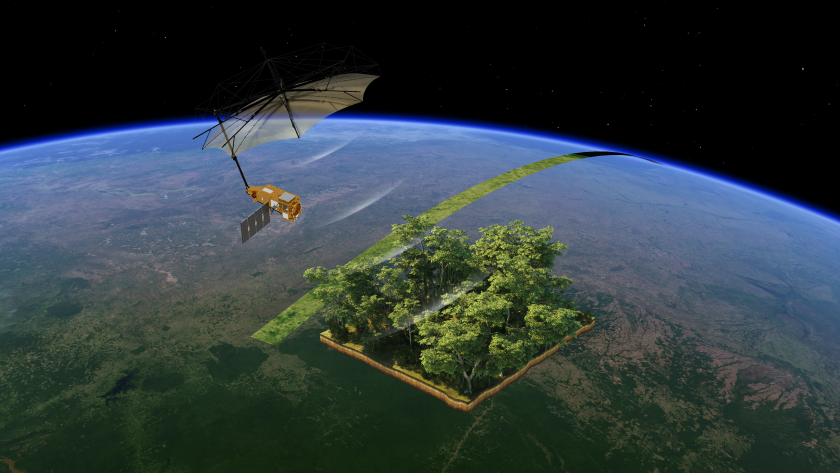
On April 29, 2025, from Europe’s Spaceport in Kourou (French Guiana), the Biomass satellite was successfully launched. This pioneering mission from the European Space Agency (ESA) promises to transform our understanding of forests and their role in the global carbon cycle.
What is the Biomass Satellite?
Biomass is the first satellite to carry a P-band synthetic aperture radar, enabling it to penetrate dense forest canopies and directly measure woody biomass—trunks, branches, and stems—where most forest carbon is stored. This unique technology will provide unprecedented data on carbon stocks and forest changes worldwide.
Why does it matter?
Forests are vital in the fight against climate change. They absorb around 8 billion tonnes of CO₂ annually, acting as massive carbon sinks. However, deforestation and forest degradation, especially in tropical regions, are reversing this effect, releasing stored carbon back into the atmosphere.
A major challenge has been the lack of accurate data on how much carbon forests hold and how those levels are changing. Biomass addresses this gap, offering detailed insight to support science-based climate and conservation policies.
What Biomass will achieve
- 📊 Reduce uncertainties in carbon stock and flux estimates.
- 🌳 Accurately assess forest loss, degradation, and regrowth.
- 🛰️ Support climate action with robust scientific data.
- 🧬 Contribute to understanding biodiversity loss, habitat change, and subsurface geology.
Developed by over 50 companies led by Airbus UK, Biomass now joins ESA’s prestigious Earth Explorers mission family.
As Simonetta Cheli, ESA’s Director of Earth Observation Programmes, stated:
“With Biomass, we are poised to gain vital new data on how much carbon is stored in the world’s forests, helping to fill key gaps in our knowledge of the carbon cycle and, ultimately, Earth’s climate system.”
Source: Agencia Espacial Europea – ESA

[…] English Version […]